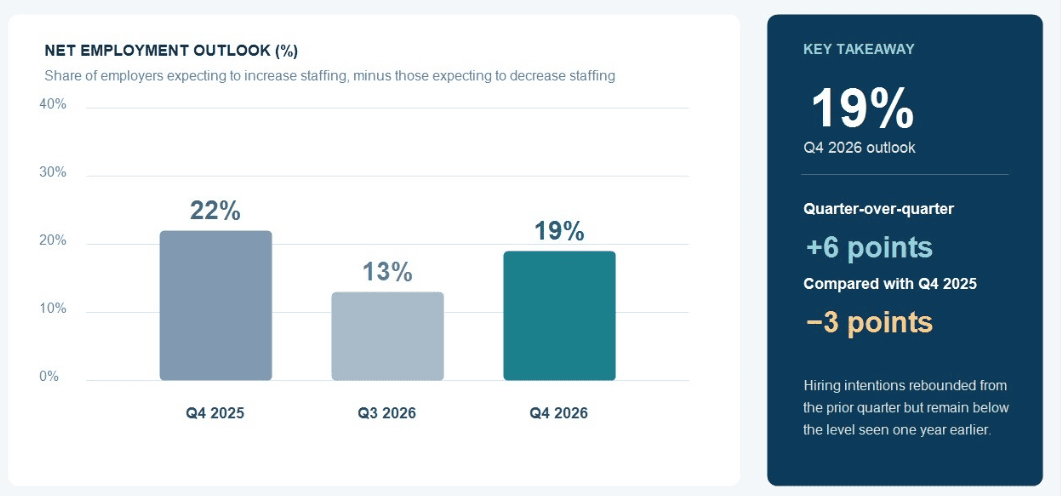
Canada’s Q4 2026 Net Employment Outlook rose to 19%, up six points from Q3. The measure drawn from the ManpowerGroup Employment Outlook Survey reflects the balance between employers planning to add staff and those expecting to reduce headcounts. The gain points to renewed employer confidence after a more cautious stretch, but the stronger interpretation is selective growth rather than broad-based expansion: employers are stabilizing core headcount while directing new hiring momentum toward specific talent levels, regions, and sectors.
Entering the closing months of the year, a growing share of Canadian employers are planning to expand their teams, and junior talent is positioned to lead that expansion. As the sections below show, this is where Q4’s momentum is most visible.
WHAT THE NATIONAL OUTLOOK REALLY SIGNALS
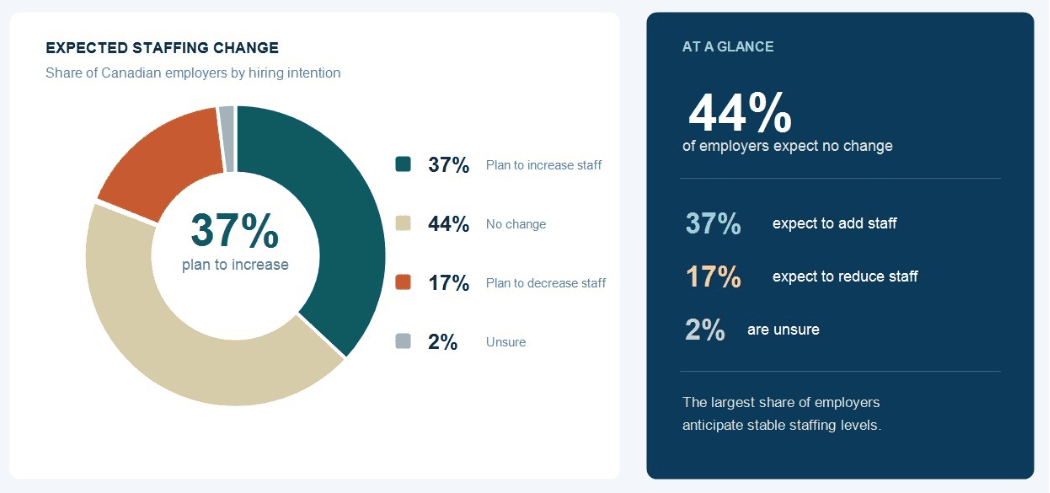
The staffing breakdown behind Canada’s 19% Net Employment Outlook points to a labor market that is measured and steady rather than stalled. According to the report, 37% plan to expand their teams next quarter; 44%, the largest group, plan to hold headcount steady, and 17% expect to reduce staff.
The 44% “no change” figure is worth reading generously: it reflects a market that has stopped contracting and is now holding a solid, defensible baseline while conditions continue to firm up, with the real growth concentrated in junior roles.
JUNIOR HIRING IS THE CLEAREST GROWTH SIGNAL
The report’s data highlights a promising trend for early career professionals. Twice as many employers report increasing their consideration of entry-level candidates than employers reducing entry-level hiring g. Rather than pulling back in uncertain conditions, organizations are actively creating pathways for new talent, treating early career hires as essential investments for long-term growth.
- 40% of employers are increasing consideration for entry-level candidates
- 20% of employers report pulling back on junior hiring
- 53% of Utilities and Natural Resources employers plan to hire more junior talent in Q4
Research from Resume.org indicates that a fifth of employers surveyed have suspended entry-level hiring because of artificial intelligence, with more employers planning similar pauses over the next two years. This shift does not invalidate immediate hiring growth; rather, it indicates that current investments in early career talent are highly intentional. Recruiters and hiring teams who are building the business case for entry-level headcount within their own organizations will benefit from clear, concrete evidence of the value entry-level hires deliver, rather than leaning on favorable survey sentiment alone
WHERE THE DEMAND IS CONCENTRATED
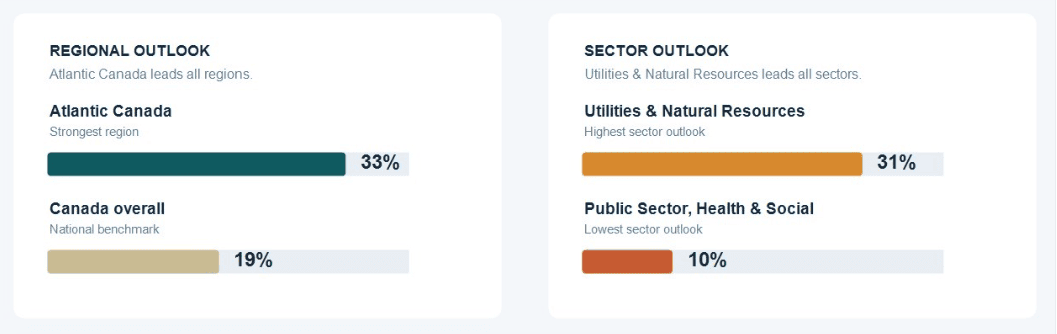
Every Canadian region reported both a positive hiring outlook and an improvement over Q3, a broad, encouraging signal of recovery. Some regions are pulling ahead of the pack; Atlantic Canada leads all regions with an outlook of 33%, well above the national benchmark of 19%. By industry, Utilities & Natural Resources posted the strongest outlook of any sector, at 31%, along with the largest year-over-year improvement, while Public Sector, Health & Social Services trails at 10%, the softest reading in the survey.
For recruitment planning, Atlantic Canada and the Utilities & Natural Resources sector stand out as the two areas most likely to generate near-term openings, and both regions also happen to be where entry-level hiring intent runs highest, making Atlantic Canada and Utilities & Natural Resources a smart, near-term focus for candidate pipelining ahead of Q4.
AI IS RESHAPING HIRING, NOT SIMPLY SPEEDING IT UP
Canadian employers have widely adopted AI tools across recruitment, and the payoff is real, just not in the way many expected. Most employers have not yet seen AI translate into shorter hiring timelines. Instead, the survey suggests AI is delivering its clearest wins by supporting human decision-making rather than replacing it: employers are reporting genuine gains in candidate targeting, employee-referral programs, and workflow approvals.
The remaining hiring delays trace back to challenges AI cannot fix on its own: skill shortages, high application volumes, and workforce planning that has not yet caught up with demand. Skill shortages, application volume, and workforce planning all sit squarely within HR’s own control to address. Addressing them directly is, in many ways, good news: the near-term opportunity is to pair AI with focused human effort, using the technology to manage volume and surface better-matched candidates while treating the harder work of closing skill gaps as a genuinely human-led priority.
Source: Jim Wilson, Entry-level, overall hiring outlook show improvement in Canada, report, Canadian HR Reporter, September 8, 2026. Read at: Entry-level, overall hiring outlook show improvement in Canada: report